Ilankai Tamil Sangam30th Year on the Web Association of Tamils of Sri Lanka in the USA |
|||
 HomeArchives HomeArchives |
Title
The reference to Eelam as an independent sovereign political unit is being controverted by people with no idea of South Indian or Sri Lankan history and even people with a smattering of South Indian history, let alone Sri Lankan history. People with vested political interests are making use of this ignorance to promote their goals. In this brief outline, some rock solid facts are brought out to demolish those imaginary arguments. Literary Evidence: In the Tamil Sangam classics we find poems of a poet by the name Eelattu PootanTevanar. We find that he is being called Madurai Eelattu PootanTevanarlater on. We can infer that in recognition of his high academic status, the King of the Pandyan territory must have given him an honorary citizenship in the capital Madurai.
In the Sangam anthology Ten Idylls there is a reference in the poem Pattinapalai to food items being imported from Eelam and other articles being imported from Myanmar [1]. This shows that Eelam was not within the political authority of the Pandyan kings. Chinese Records: Chinese sea faring started late by about the sixth century AD. But they had land contacts earlier. Sri Lanka has been known to the Chinese by various names.
Doe in Chinese means Island while gua means country. This means that the Chinese have had trade dealings with Eelam. The South Indian Port of Kollam (Kolambam) now in Kerala, was the life wire of sea borne trade of yonder years, especially silk route days. Eelam, at its southern tip, and within the same sea borne activity area, also had a lucrative sea borne trade. Epigraphic Evidence: We have reference to Eelam in two significant inscriptions from Madurai, the glorious capital of the Pandyan territory. One is from Thirupparangkunram . According to this inscription dated to second century BC it was indited by a person from the country called Eelam [3]. The word Eela kutumpikan is significant. Kutumpu in Tamil means an independent political unit [4]. This shows that Eelam was outside the domain of the Pandyan suzerainty. The other inscription is from Alagar malai. It refers to a king from Eelam who contributed much to the construction of tanks – Eela vavi rayan. – One who promoted hydraulic civilization like Karikalan who built the Kallanai, the ancient anicut of Tamil Nadu [5]. The significance is the reference to the tank builder as King of Eelam. That means Eelam was a sovereign independent State. Incidentally, it may be noted that the Vels played a great role in the promotion of hydraulic civilization both in Tamil Nadu [6] and Sri Lanka [7]. The Anuradhapura Tamil Householders Inscription refers to Eelam as a blessed land from where those mentioned in that inscription had come [8]. The inscription is clear although Paranavitane had wrongly read it as Ilubarata. In Prakrit language there is no V sound. V is represented by B Paranavitane is not conversant with Indian Hindu traditions. It is clearly written as Eela B (V)rta Dameda-
The B (
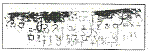
Dameda again has to be read as Damela or Damila following the readings of similar writing from Kodumanal in Tamil Nadu in India. Mahadevan has dwelt on this in detail [10] Eelam is mentioned in the Tamil inscription of the great Chola King Rajendra 1 found on a pillar retrieved from the Jaffna Fort. This inscription can be dated to the eleventh century AD. The inscription refers to King of Eelam and hence it has to be concluded that Eelam was a sovereign independent Kingdom even at that time [11]. The Tamil Kingdom lost its sovereignty to the Portuguese after a long bitter and bloody battle in 1619. The Tamils were never under Sinhalese kings. Even Parakrama Bahu VI who conquered the Tamil Kingdom was himself a Tamil King though he ruled the Kotte Kingdom. This did not last long as the Tamil kingdom was soon retrieved from the Kotte kingdom and was independent till 1619. Vallipuram Inscription
Anuradhapura Inscription
----------------------------------------------------------------------------------------------- Footnotes
|
||
|
|||
 One of the names is Eelam. They called it Eelamdoe ( --ஈழம்டோ) [2].
  (ஈழவர்த தமேத -ஈழத்திருநாட்டு தமிழர் - ) – something comparable to Hindu traditional usage Arya Vrta – ஆரியவர்த, and Brahma Vrta – பிரமவர்த.
  ) has to be taken as V (
 ) and has to be read as Eela Vrta Dameda
  (ஈழவர்த தமேத -ஈழத்திருநாட்டு தமிழர் - ) It would mean Tamils from the blessed land of Eelam. There is a parallel. In the Vallipuram gold sheet inscription, because there is no V sound in Prakrit, Vadakarai -வடகரை
  ( ) is written as Badakara (
  ) and Paranavitane has read it as Badakara atana. However Kanapathipillai has correctly read it as Vadakarai atana-வடகரை